The Hidden Cost of Rework You're Not Measuring
Your machines have an hourly rate. Your material has a price. Your rejections have neither — which is exactly why they quietly eat your profit.
The shop is busy. Machines running all day, operators on their feet, orders going out. By every visible sign, business is good.
Then the month closes, and the profit isn't there — not the way it should be, for all that activity. The owner frowns at the numbers and puts it down to rates, or the market, or a tough party. The real reason rarely gets named, because it never shows up anywhere you'd think to look.
Part of all that busy machine time wasn't making new work. It was re-making rejected work. And nobody counted it.
The cost with no entry in any register
Walk through your shop's costs, and you can name most of them. Material has a price per kilo. Machines have an hourly rate. Labour has a wage. Power, rent, tooling — all of it sits somewhere you can see it.
Rejection sits nowhere. There is no register for it. When a piece fails, the material is already spent, the machine hours are already gone, and the only "record" is a vague sense that this part "gives some trouble." So it gets absorbed, month after month, into the cost of doing business — unmeasured, and therefore unquestioned.
What you don't measure, you can't fix. And rejection is the biggest cost in most shops that nobody measures.
What it costs
Rejection is expensive twice over, because every rejected piece has to be made again.
Take a part running, say, 12% rejection — not unusual, and easy to miss. On 500 pieces a month at ₹150 of material and machining each, that's 60 pieces failing. Sixty pieces of material bought for nothing: ₹9,000 a month. Then the machine hours to make those sixty a second time — hours that could have run paying work. Then the labour, the re-setup, the inspection done twice.
And the part that hurts most: every hour spent re-making a rejected piece is an hour not spent on a new order. The work you could have taken instead is often worth more than the scrap itself.
One quietly troublesome part, never measured, can drain more from a shop in a year than a machine breakdown would — and unlike the breakdown, nobody ever notices it happen.
The real cause
Here's why it stays hidden. In most shops, rejection is felt, not counted. There's no number for it, per part or per job — just an averaged-out sense that "this is how it is."
So the part throwing 12% and the part throwing 2% look the same from the owner's chair. The bad one never announces itself. The problem you can't see is the problem you never fix — and it runs for months, sometimes years.
What actually fixes it
The fix is almost insultingly simple: count it.
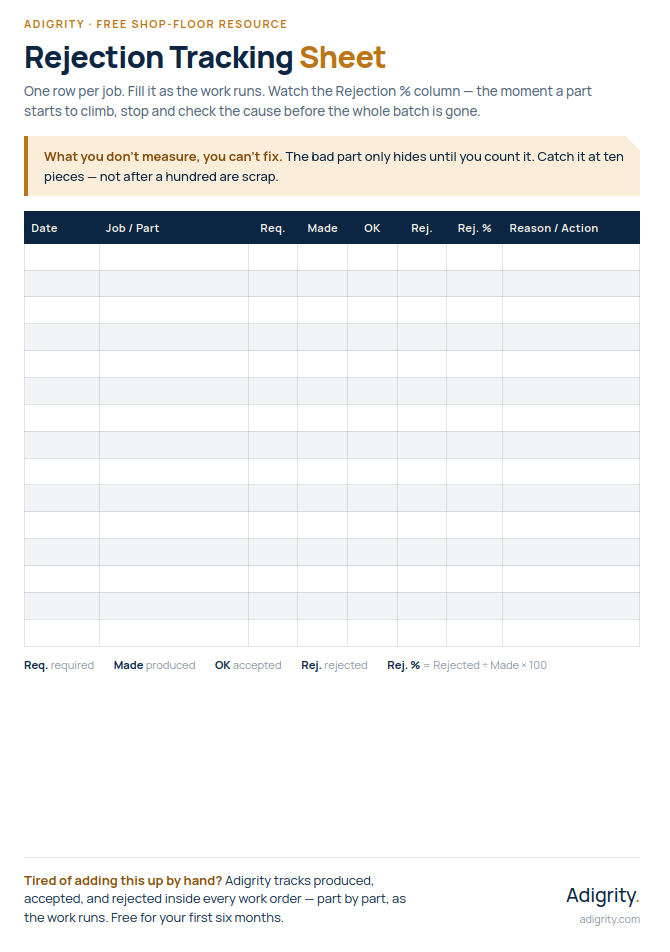
For each job, track four numbers — how many were required, how many were produced, how many were accepted, and how many were rejected. The moment you do, two things change.
First, the troublesome part stops hiding. When you can see rejection by part, the bad one stands out instantly, and you can go fix the cause — the tooling, the setup, the drawing — instead of bleeding quietly forever.
Second, you catch problems early. When you're tracking as you go, a part throwing rejections shows up at ten pieces, not after the full batch of a hundred is already scrap. That difference alone pays for the effort many times over.
Measurement turns a vague monthly disappointment into a number you can act on this week.
This is built into how Adigrity handles work orders. For every part in a job, you record produced, accepted, and rejected as the work happens, and it shows you the rejection right there — part by part, job by job. The cost that used to hide in a feeling becomes a number on a screen, early enough to do something about.
One thing to do this week
Pick one job running now, and simply start counting: required, produced, accepted, rejected. Even on paper. You'll likely be surprised by what you find — and that surprise is the first money you'll save.
To make it easy, we've put together a one-page Rejection Tracking Sheet you can print and keep at the machine. Fill a row per job, watch the rejection column, and act the moment a part starts to climb.
 [ Download the Rejection Tracking Sheet ]
And when you want the version that adds itself up — every part's rejection tracked as the work runs — Adigrity does it inside every work order. Free for your first six months.
Want the full picture? Read our guide to running a job from start to finish, or set up your shop in a few minutes at adigrity.com.